Five Albanian Cities That Deserve Way More of Your Time Than Tirana Gets
Tirana is great. We'll say it plainly: Albania's capital is one of the most underrated urban experiences in Europe, and if you haven't been, you should go. But here's the thing about Tirana — it's the easy choice. It's where the flights land, the English menus are plentiful, and the tourist infrastructure is fully developed. And for that reason, it's also where most visitors stop.
That's a mistake.
Albania's secondary cities are where the country's layers actually reveal themselves. Where the Ottoman architecture isn't curated for Instagram but lived in. Where the restaurant owner is also the fisherman. Where you might be the only American in the room — and that's entirely the point.
Here are five cities that belong on your Albanian itinerary, and what makes each one worth the detour.
Durrës: Two Thousand Years of History Hiding in Plain Sight
Durrës sits about forty minutes west of Tirana on the Adriatic coast, and it is, without exaggeration, one of the oldest continuously inhabited cities in the world. Founded by Greek colonists in the 7th century BC, it became a major Roman port city — Dyrrachium — and sat at the western terminus of the ancient Via Egnatia, the road that connected the Adriatic to Constantinople.
All of that history is still very much present. The city's Roman amphitheater, discovered in the 1960s during construction work, is embedded directly into the urban fabric — you can peer down into its excavated tiers from street level, or walk through partially restored sections that give a real sense of its original scale. The archaeological museum is one of the best in the Balkans, housing artifacts that span millennia of Illyrian, Greek, Roman, and Byzantine occupation.
Modern Durrës is a port city with a working-class energy that some travelers find jarring after Tirana's polished Blloku district. Don't let that put you off. The seafront promenade is lively on summer evenings, the fish restaurants are excellent and cheap, and the city's mix of crumbling Ottoman-era buildings and socialist-era apartment blocks has a raw, unfiltered quality that feels honest in a way that heavily touristed places rarely do.
Where to eat: The seafront restaurants near the port serve grilled fish that's about as fresh as it gets anywhere in Europe. Order whatever came in that morning.
Where to stay: Durrës has a range of options from budget guesthouses to mid-range hotels near the beach. It's also close enough to Tirana to work as a day trip if you're based in the capital.
Vlorë: The City Where Albanian Independence Was Born
Vlorë doesn't always make the shortlist for American travelers, which is baffling once you understand what it is. This is the city where Albania declared independence from the Ottoman Empire on November 28, 1912 — a date that every Albanian knows the way Americans know July 4th. The Independence Monument and the Flag of Independence Museum are genuinely moving places to visit, not in a dusty-exhibit way but in a way that makes the country's history suddenly feel immediate and human.
Beyond the historical significance, Vlorë is a real city with a university, a young population, and a beach scene that's been attracting domestic tourists for decades. The Bay of Vlorë is one of the most beautiful natural harbors in the Mediterranean, and the surrounding landscape — including the Karaburun Peninsula, accessible only by boat — is spectacular enough to justify an extra day or two.
The Karaburun-Sazan Marine National Park, just offshore, is one of the best diving destinations in the Adriatic, with clear water, dramatic underwater topography, and wrecks that include a WWII-era Italian submarine.
Where to eat: The old bazaar area has a cluster of traditional restaurants serving qofte (Albanian meatballs), tave kosi (baked lamb with yogurt), and grilled seafood. Eat here rather than the tourist-facing spots near the beach.
Where to stay: Vlorë has a growing selection of boutique guesthouses that offer much better value than the larger hotels. Book direct for the best rates.
Gjirokastër: A UNESCO City That Feels Like a Film Set (But Isn't)
If you only visit one city beyond Tirana, make it Gjirokastër. This UNESCO World Heritage Site in southern Albania is built on a hillside above the Drino River valley, its steep cobblestone streets lined with characteristic Ottoman houses — tall, slate-roofed structures with overhanging upper floors and fortress-like stone bases — that look like they were designed by a particularly dramatic production designer.
They weren't. This is just what Gjirokastër looks like.
The citadel at the top of the hill houses a weapons museum, a captured American spy plane from the Cold War era (yes, really), and panoramic views over the valley that are genuinely breathtaking. The old bazaar at the base of the castle hill has been restored and is home to artisan workshops, small cafes, and shops selling the copperwork and textiles that the city has produced for centuries.
Gjirokastër is also the birthplace of two of Albania's most significant 20th-century figures: the writer Ismail Kadare, whose novels offer the most accessible entry point into Albanian history and culture for English-speaking readers, and the communist dictator Enver Hoxha. Their childhood homes are both preserved and open to visitors — a strange juxtaposition that says something interesting about how Albanians are navigating their complicated recent past.
Where to eat: The guesthouses in the old bazaar area typically serve the best food in town — home-cooked Albanian meals using local ingredients. Don't skip the local wine.
Where to stay: Staying in a traditional stone guesthouse within the old city is the only way to fully experience Gjirokastër. Book early in summer — the good ones fill up.
Berat: The City of a Thousand Windows
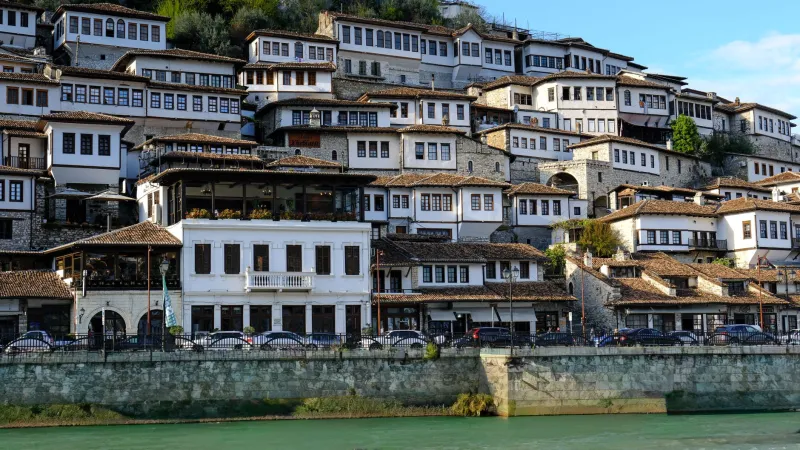
Berat's nickname — "the city of a thousand windows" — comes from the rows of Ottoman-era houses climbing its hillsides, their large windows stacked in symmetrical tiers that catch the afternoon light in a way that stops you mid-sentence. Like Gjirokastër, Berat is a UNESCO World Heritage Site, and the two cities are often paired on southern Albania itineraries — they're about ninety minutes apart by road.
But Berat has its own distinct character. Where Gjirokastër feels dramatic and slightly austere, Berat is warmer, more intimate. The Mangalem quarter on one side of the Osum River and the Gorica quarter on the other are connected by a stone bridge that's been photographed approximately ten million times and still looks incredible in person. The castle hill above the city is actually a living neighborhood — people still live within its walls — and wandering its lanes feels less like a museum visit and more like stumbling into someone's backyard.
Berat's history includes significant Christian Byzantine and Orthodox heritage, and the Onufri National Museum inside the castle houses one of the finest collections of Byzantine iconography in the Balkans. Onufri, the 16th-century Albanian painter, developed a distinctive use of red pigment that art historians still argue about. Even if you're not an art history person, the icons are stunning.
Where to eat: The restaurants along the riverbank in Mangalem are reliable and atmospheric. Local Berat wine — the region produces decent reds — pairs well with whatever you order.
Where to stay: Small family-run guesthouses within the old quarters offer the most authentic experience and the best value.
Shkodër: The Cultural Capital of the North
Rounding out the list is Shkodër, Albania's fourth-largest city and the undisputed cultural hub of the country's north. Sitting at the confluence of the Drin and Buna rivers near the southern shore of Lake Shkodër — one of the largest lakes in Europe — the city has a distinct personality shaped by its long history as a trade and artistic center.
Shkodër is known for its vibrant arts scene, its cycling culture (it's one of the few Albanian cities where bikes are a serious mode of transportation), and its remarkable religious diversity — Catholic churches, Orthodox churches, and mosques exist within blocks of each other, a physical reminder of the city's layered history. The Rozafa Castle, perched on a rocky hill above the city, offers some of the best views in the country, stretching across the lake toward Montenegro's mountains.
For travelers heading toward the Albanian Alps — the Accursed Mountains — Shkodër is also the natural staging point. The city's guesthouses are well-practiced at helping hikers and adventurers plan their routes into the Valbona and Theth valleys.
Where to eat: The pedestrian street in the city center has a solid range of cafes and restaurants. For something more local, ask your guesthouse for their recommendation — the best places in Shkodër rarely need a sign.
Where to stay: Shkodër has a well-developed guesthouse network aimed at hikers and cultural travelers, with prices that will make you feel like you're getting away with something.
The common thread across all five of these cities is that they reward slowness. Don't drive through Berat in two hours and check it off a list. Stay a night. Eat where the locals eat. Get lost in the old quarter. Albania's secondary cities have been quietly accumulating centuries of history, and they're not in any rush to give it all up at once.