Sun, Sand, and Savings: Albania's Coastline Beats the Greek Islands at Half the Price
The Beach Vacation Math Nobody Is Doing
Let's be honest: most Americans planning a Mediterranean beach trip go straight to Greece. And honestly, who can blame them? Santorini's blue-domed churches are everywhere on Instagram. Mykonos has that effortless cool-kid energy. But here's the thing nobody's talking about at your travel agent's office — Albania's coastline is sitting right next door, offering the same cerulean water and dramatic landscapes, and it's doing it for roughly half the price.
We're not talking about a compromise destination. We're talking about places that will genuinely make your jaw drop — and leave enough cash in your wallet to extend the trip by a week.
What You're Actually Getting on Albania's Coast
Albania's shoreline splits into two distinct personalities. To the west, the Adriatic coast runs from the port city of Durrës down toward the border with Montenegro — wide sandy beaches, lively promenades, and easy access from the capital, Tirana. To the south, the Ionian Riviera is where things get truly cinematic.
The Albanian Riviera hugs the country's southwestern edge, stretching roughly 90 miles from Vlorë down to the Greek border near Sarandë. The mountains of the Ceraunian range tumble almost directly into the sea here, creating a series of secluded coves, hidden beaches, and cliff-top villages that feel like they belong in a movie set — except they're completely real, and remarkably uncrowded.
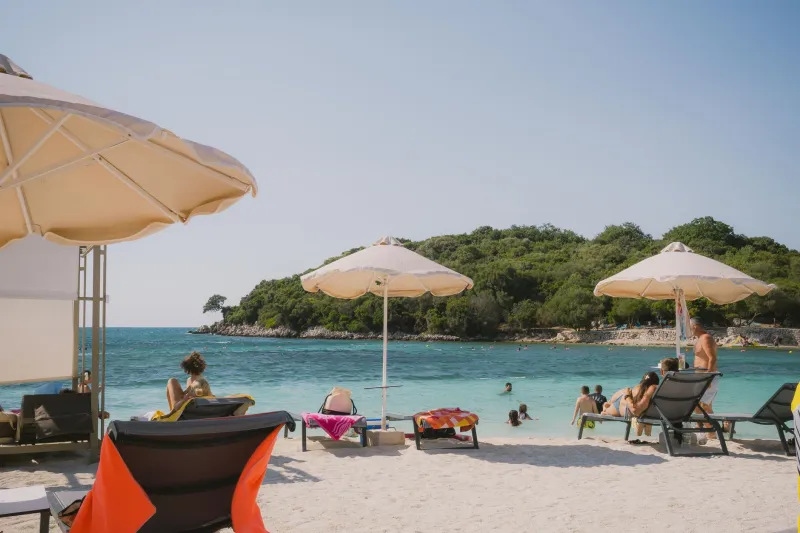
Ksamil is the name that comes up most often among travelers who've made the switch from Greece, and for good reason. This small village near Sarandë sits across from the Greek island of Corfu — so close you can see it from the beach — and offers a cluster of tiny islets ringed by water so clear it looks digitally enhanced. Umbrella and sunbed rentals run about $5 to $10 a day. A fresh seafood lunch with a cold local beer? Expect to pay somewhere between $10 and $18 total. Compare that to the $40-plus you'd drop for a similar meal on a Greek island, and the math starts looking pretty compelling.
Dhermi is a different vibe entirely — a whitewashed hillside village that spills down toward a long crescent beach flanked by olive groves and rocky headlands. The water here shifts between shades of deep turquoise and jade depending on the time of day, and the beach itself is the kind of place where you can actually find a quiet spot even in July. Boutique guesthouses in Dhermi run anywhere from $50 to $90 a night for a double room with breakfast included. Equivalent accommodations on the Amalfi Coast or Greek islands? You're looking at $200 and up, easily.
Himara sits between the two and deserves its own mention. It's a small coastal town with a laid-back energy, a genuinely good local restaurant scene, and access to several nearby beaches — including Livadhi and Potami — that rarely show up on tourist maps. Himara feels like the kind of place you discover and then spend the rest of the trip telling everyone else about.
The Crowd Question (This Is Where It Gets Interesting)
One of the biggest complaints about the Greek islands in peak summer — especially Santorini and Mykonos — is the sheer number of people. Cruise ships disgorge thousands of visitors daily. Popular beaches become standing-room-only situations. Restaurants require reservations days in advance.
Albania's Riviera doesn't have that problem yet. The country has been investing heavily in tourism infrastructure over the past decade, and visitor numbers are climbing — but they're climbing from a very low baseline. Even in August, which is the busiest month by far, you can find stretches of beach in Dhermi or around Himara where you're sharing the water with a handful of other people rather than a crowd.
That said, Ksamil does get genuinely busy in July and August, particularly on weekends when visitors from Tirana and neighboring Kosovo arrive en masse. If you want the full paradise experience there without the crowds, aim for late May through mid-June, or the first two weeks of September. The water is still warm, the prices drop slightly, and the beaches feel like they belong to you.
Breaking Down the Real Costs
Here's a rough daily budget comparison that might help put things in perspective:
Greece (Santorini, peak season):
- Mid-range hotel: $200–$350/night
- Meals (3x daily): $60–$90
- Beach chair/umbrella rental: $25–$40
- Activities/transport: $40–$60
- Daily total: $325–$540
Albania (Dhermi or Ksamil, peak season):
- Mid-range guesthouse or hotel: $50–$100/night
- Meals (3x daily): $20–$35
- Beach chair/umbrella rental: $5–$10
- Activities/transport: $15–$30
- Daily total: $90–$175
On a ten-day trip, that difference compounds fast. You could realistically spend $2,000 to $3,500 less in Albania than in Greece — and use that money to hire a private boat for the day, take a guided hike through the Llogara National Park, or simply extend the trip and see more of the country.
Getting There Without Losing Your Mind
Flying into Albania directly from the US typically means a connection through a European hub — London, Rome, Vienna, and Istanbul are all common layover points. Tirana's Mother Teresa International Airport handles direct flights from a growing number of European cities, and once you're in the capital, the Riviera is a three-to-four hour drive south along a road that is, frankly, one of the more spectacular drives in the Balkans.
Alternatively, many travelers fly into Corfu — which has strong transatlantic connections through Athens — and take a short ferry ride across to Sarandë. This actually makes for a fantastic trip structure: start in Corfu, cross into Albania, work your way up the Riviera, and finish in Tirana before flying home. Two countries, one coastline, zero regrets.
The Honest Caveat
Albania isn't Greece in terms of tourism infrastructure, and that's worth acknowledging. Some roads along the Riviera are narrow and winding. English isn't as universally spoken in smaller villages. A handful of beaches still lack the polished amenities you'd find at a high-end Greek resort.
But here's the flip side of all that: the food is fresher and more local, the people are genuinely warm in a way that doesn't feel transactional, and the experience feels like discovery rather than consumption. You're not following a well-worn tourist trail — you're finding something real.
The Window Is Open, But It Won't Stay That Way
Albania's coastline is having a moment. Travel publications are starting to notice. Boutique hotels are opening. Flight connections are improving. The secret is getting out, slowly but surely. The travelers who show up now — before the Instagram crowds arrive and the prices adjust accordingly — are going to be the ones telling the best stories.
Greece will always be there. Albania's beaches, at these prices and with this level of quiet, might not be forever. That's reason enough to start planning.